Posts

Wild Things

Image
Americans are prudes.  Sure, we can handle an all-you-can-eat buffet of over-the-top violence, but when it comes to people bumping their naughty parts together, we fall back on our puritanical instincts, at least as far as mainstream cinema is concerned.  There was a brief renaissance though in the ‘90s that began with Basic Instinct  and bled into notorious thrillers like  Sliver ,  Body of Evidence  and  Color of Night where a healthy dose of bloodletting helped the sexy parts go down.  1997’s  Wild Things  was really the last hurrah for this Cinemax-inspired sexual awakening, marketed around a must-see threesome between stars Matt Dillon, Neve Campbell and Denise Richards. Sam Lombardo (Dillion) is a high school guidance counselor and well-known lothario among the upper crust housewives in as exclusive Florida community.   That reputation comes back to haunt him when he’s accused of rape by two stude...

The 8 Diagram Pole Fighter

Image
The wave of Shaw Brothers films continues – as does the online argument about which titles are most  essential  – with Arrow Video’s Blu-ray release of  The 8 Diagram Pole Fighter , the studio’s 1983 spear-poking, eye-gouging, tooth-shattering ballet of kung fu artistry.  While the formula was growing a bit tired at this point, there’s still some amazing choreography and physical prowess on display in nearly every scene. The plot certainly doesn’t break any new ground.  After suffering a crushing defeat in battle, the two surviving brothers of the Yang family go into hiding; the PTSD-afflicted  6 th   son under the protection of his sisters, while the  5 th  joins a monastery to train for his revenge.  While the treacherous Mongols search the kingdom for the remaining brothers, the Yang  sisters  enter the fray to restore the family name.   The death of Alexander Fu Sheng (who plays the 6 th  son) neces...

Twisting the Knife: Four Films by Claude Chabrol

Image
Unlike his French New Wave contemporaries, director Claude Chabrol was never obsessed with reinventing the form of cinema.  And despite emulating Hitchcock’s penchant for thrillers and psychological quirks, his film career was closer to the work of John Ford: a solid craftsman who could bounce between genres but always bring along something of himself. Twisting the Knife: Four Films by Claude Chabrol  is the latest in Arrow Video’s box sets of the director’s later work, this time encompassing four titles released between 1997 and 2003.  Each film includes the typical Chabrol ingredients – sex, murder and copious amounts of emotional baggage – but varies the formula with even greater success than the previous set released last year.   The Swindle  (1999) is the most lighthearted of the bunch, with a small-time father-daughter pair of crooks staging a heist that puts them a new league financially.  Unfortunately, that reward comes bigger risks…...

Robocop 4K HDR

Image
Robocop  is a film that shouldn’t have succeeded on any level, starting with a title that even its own writers found embarrassing.  But somehow Dutch director Paul Verhoeven turned the script’s trite sci-fi escapism into a hilariously brutal satire of American capitalism – and still managed to keep the action fast and furious. Peter Weller is Murphy; an honest cop who is brutally murdered then resurrected as the future of law enforcement, Robocop.  Fighting his scattered human memories, along with the corrupt executives within OCP, the Reagan-era mega-corporation that now own old-Detroit, Murphy finds himself torn between his programming and his cop instincts. His partner Lewis (Nancy Allen) helps him bring down the bad guys and restore his humanity.   Not only does  Robocop  work as a gruesome sci-fi adventure (especially in the longer unrated cut included here), but its barbed-wire wit cuts right to the core of 80’s excess, particularly the laug...

12 Monkeys 4K HDR

Image
Although Chris Marker's 1962 short film  La Jetee  is part of the basic text in film schools across the country, the time travel photo play was generally unknown to mass audiences.  Which made its clever conceit of a man witnessing his own death as a child the perfect starting place for  Twelve Monkeys  (1995), a much more elaborate (and needlessly complicated) extrapolation of Marker's themes of love, loss and memory. A post-apocalyptic "volunteer" sent back to the '90s to gather information on the disease that will destroy humanity, James Cole (Bruce Willis) is promptly locked up in a mental institution where he befriends fellow inmate Jeffrey Goines (Brad Pitt).  A genuine psychotic with nihilistic tendencies, Goines is in turn inspired by James' alternate reality, plotting to use his father's medical research facility to return the world to its true owners: the animals.  James eventually convinces his psychiatrist Madeleine Stowe) to...

Thriller: A Cruel Picture

Image
The rape-revenge exploitation subgenre it a tough one to defend, especially in the “Me Too” era.  While its female protagonists typically punish the men responsible for their physical and emotional degradation in pleasingly painful ways, the films make us (as male viewers especially) complicit in the initial attack itself in often titillating fashion. There’s no doubt we’re supposed to  feel  the character’s pain, but are we being asked to  enjoy  it as well?   It's an uncomfortable question.  And  Thriller: A Cruel Picture  (released in the U.S. as  They Call Her One Eye ) continues to straddle the philosophical fence, punishing its mute heroine from frame one then letting her wreak bloody vengeance for a lifetime of male (and female) oppression.   No small surprise that Tarantino found enough inspiration in this offensive cult classic to reference its character in the  Kill Bill  saga.   Mad...

Rogue Cops & Racketeers

Image
Director Enzo G. Castellari doesn’t attract the same kind of attention as his fellow genre-workhorses in Italian cult cinema circles.  Perhaps because his films never went overboard on gore (like Fulci) or caught on with U.S. distributors (like Leone).  On the whole, Castellari’s work is indistinguishable from other films of the period: fast-paced knock-offs of  Death Wish  and  The French Connection .  But the action scenes, which vacillate between Peckinpah-inspired slow-motion and whip-pan intensity, are cinematic creations unto themselves.  Castellari puts his camera right in the thick of things – tumbling weightless off a cliff, between the headlights of a muscle car, or popping off a thug through a 1-inch diameter pipe.  There’s an energy to his choice of angles, a devil-may-care inventiveness to his staging that was an obvious influence on modern-day filmmakers.   And  The Big Racket  finds the d...

To Sleep So as to Dream

Image
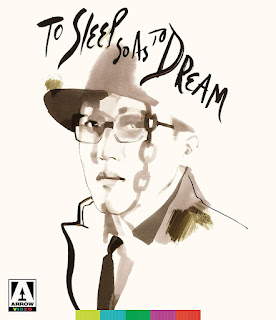
As the birth of cinema gets pushed further and further into history, fewer filmmakers – and audiences – find much fascination with its origin story.  Certainly 2011’s Oscar winner  The Artist  was a trendy outlier but the era of silent movies is about on par with reading Latin for relaxation as far as most viewers are concerned.  And Kaizo Hayashi’s  To Sleep So as to Dream  (1986) presents its  own  challenges as a post-modern play on film noir, silent cinema and experimental techniques all at the same time. A pair of sleuths are hired by a mysterious woman to track down her kidnapped daughter, following a set of riddles and an ever-increasing ransom that will ensure her safe return.  But the detectives become unwitting participants in the finale of a banned silent movie that never reached its conclusion onscreen…and now must bleed into real life.   That is if  anything  about  To Sleep So as to  Dream...

Mary Shelley's Frankenstein

Image
The birth of Frankenstein’s monster is a singular moment in cinematic history.  Director James Whale imbues the scene with all the sound and fury worthy of Victor’s scandalously sacrilegious ambition, capped off by one of the most quotable bits of dialogue ever uttered: “It’s alive!”  It’s a tough act for Kenneth Branagh, director and star of 1994’s  Mary Shelley’s Frankenstein , to follow.  But stripping down to the waist and leaping about the laboratory with  Flashdance - style vigor is most decidedly  not  an improvement.  It’s the first of  many  misguided decisions in this follow-up to Coppola’s equally baroque – but much more visually interesting –  Bram Stoker’s Dracula ; a classic monster resurrection that bottomed out with  Wolf  with same year. Like Coppola’s film, putting Shelley’s name above the title suggests a certain amount of respect for literary accuracy.  But the script diver...

Come Drink with Me

Image
Perhaps the most lyrical and artistic film in the Shaw Brothers catalog,  Come Drink with Me  (1966) doesn’t deviate much from the formula the studio would follow for the next decade (feuding outlaws, heroic renegades and all-powerful masters) but here the fighting seems more elegant, more restrained and more romantic. Golden Swallow (Chen Pei-pei) is the sister of an official held hostage by a gang of kung-fu bandits.  When negotiations fail, she must take on the gang with the aid of an inebriated local named Drunken Cat, who seems to have more skills than he lets on.  The duo find themselves outnumbered and faced with a seemingly undefeatable enemy in the form of Liao Kung, the evil abbot of the impenetrable monastery.    Directed by King Hu,  Come Drink with Me  is awash with beautiful colors, majestic backdrops and inventive fight choreography.  Despite the moments of arterial spray (a necessary ingredient in almost every S...

Deadly Games

Image
An odd entry in the slasher cycle that cops its style more from Argento’s oeuvre than the typical masked killers of the day,  Deadly Games  (1982) is just offbeat enough to be memorable, although it seems to sabotage itself at every turn.  Writer/director Scott Mansfield stages some stylish set-pieces but gets bogged down in bizarre character quirks and a cast as confusingly interchangeable as a soap opera.  Music journalist Keegan Lawrence (Jo Ann Harris) returns to her hometown after her sisters’ murder and falls back in with her old high school crowd, a misfit group of swingers who trade partners every weekend.  Roger (Sam Groom), their unofficial leader and town sheriff, seems to be getting nowhere fast with his investigation…but has  better  luck with Keegan.  As the pair grow closer, so do the murders, committed by a black-gloved killer who dispatches his victims according to a classic monsters board game.   Unmentioned i...

An American Werewolf in London

Image
An American Werewolf in London  is very nearly a perfect movie; even its flaws are charming.  Mixing comedy and horror more successfully than any film before or since, director John Landis managed to reinvigorate the lycanthrope legend while Rick Baker's effects set new standards (literally, earning him the inaugural Best Makeup Oscar) that have yet to be topped.     After an attack on the moors, David (David Naughton) is haunted by the decomposing ghost of his friend Jack (Griffin Dunne) who urges him to commit suicide before he runs wild in downtown London.   Before you know it, that's exactly what happens in a brilliantly staged standoff in Piccadilly Circus.  Only David's former nurse (Jenny Agutter) has the courage to face down the monster he's become.   After a number of appearances on Blu-ray, Arrow Video upgrades its  own  version with a 4K Ultra HD restoration.  The results are pretty damn good, esp...

Lies & Deceit: Five Films by Claude Chabrol

Image
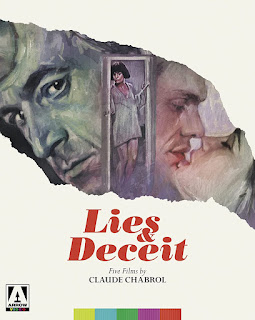
By far the most mainstream of the Cahiers du cinema critics-turned-directors, Claude Chabrol was also the most prolific, averaging almost one film a year until his death in 2010.  Often working within the Hitchcock-inspired framework of the thriller genre, the French director never received the acclaim and notoriety of contemporaries like Godard and Truffaut likely because his style hewed to the more formal visual constraints of classic Hollywood.  But even his later work - such as those collected in Arrow’s new set  Lies & Deceit:  Five Films by Claude Chabrol  – merit attention for his unique take on the flaws and (sometimes murderous) foibles of the bourgeois which lay hidden in plain sight. Cop Au Vin  (1985) and  Inspector Lavardin  (1986) star Jean Poiret as the irascible and single-minded detective called upon to stir up the quiet French countryside in search of a killer.  In the first film, it’s a real-estate s...

Sleep

Image
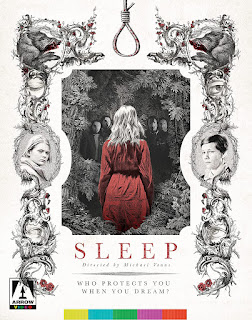
Michael Venus’ feature debut, Sleep (2021), although it becomes almost Lynchian in its obtuse imagery, is, at its heart, a mystery; one that uncovers personal, family and generational secrets.   And it’s that narrative drive that makes it so compelling…despite its sometime maddening attempts to keep audiences in the dark.   Mona races to a hospital in the small village of Stainbach where her mother, Marlene, has suffered a psychological breakdown.  Booking a room in the same hotel where the “incident” occurred, she becomes suspicious of the proprietors, Otto and Lore, whose helpful demeanor seems to disguise a sinister agenda.  The proximity triggers a series of dreams (flashbacks?) that Mona struggles to piece together, unearthing the history of a series of suicides that seem related to her own family tree and a ghostly presence that uses her for its own ends. By the time the credits roll, Sleep has resolved all its loose ends…which, in itself, separates it fro...

Shock

Image
Directors like Mario Bava are the reason cult movie fans exist.  Working under miniscule budgets with fly-by-night foreign producers who distributed the final product under a seemingly endless number of alternative titles, often just tracking down the muddy lineage of Bava’s work is a genealogical case study unto itself.  But it’s the thrill of the chase that fans enjoy most, sifting through the pseudonyms and cinematic dead-ends to unearth something truly special from a man who was 30 years ahead of his time. The last ten years have made things much simpler, with several companies stepping up to the plate to deliver stellar version of the maestro’s films.  Arrow Video’s Blu-ray special edition of  Shock  is the latest, featuring a brand-new 2K restoration from the original negative of what would be his final film, a family affair with assistance from his son – and future director himself – Lamberto Bava.  It’s a familiar tale of ghostly...

Red Angel

Image
After humbling themselves post-WW2, Japanese war films took on a decidedly grim tone early on, casting aside the propaganda that continued in American cinema until the late ‘60s.     Armed conflict was brutal, ugly and pointless; and Yasuzo Masumura’s   Red Angel   (1966) makes sure audiences get the point. Sakura Nishi (Ayako Wakao) is a nurse serving on the front lines during the Second Sino-Japanese War, not only dealing with ravaged bodies and severed limbs but the violently overactive libidos of soldiers who fear no consequences.  After being raped on the medical ward, Nishi struggles to rise above her feelings for revenge, even pleading with Dr. Okabe (Shinsuke Ashida) to save her attacker’s life.  Her mercy strikes a chord in the cynical physician and the two develop a complicated relationship that struggles to survive in the midst of near constant chaos.   Red Angel  is a love story of sorts.  Nishi does more that stitc...

Shawscope Volume One

Image
For most people martial arts films begin and end with Bruce Lee.  Not that there’s anything wrong with that.  Lee’s filmography contains some of the most stunningly choreographed fight scenes ever put on celluloid and his charismatic execution rightfully made him an international star.  But the catalog of work released by Shaw Brothers, a Hong Kong studio which specialized in kung fu exports throughout the ‘60s and ‘70s, puts its own particular brand of genius on display.  Sure, Bruce Lee might have taken on fifty guys at once…but did he ever do it with a hatchet buried three inches deep in his solar plexus?  I think not. Starting off with  King Boxer , the curated list of titles don’t follow any sort of release pattern but instead provide a loosely connected theme for newbies and experienced fans to follow.  From the satisfying training montages of  Shaolin Temple to the bugnuts insanity of  Mighty Peking Man , ...

Sailor Suit and Machine Gun

Image
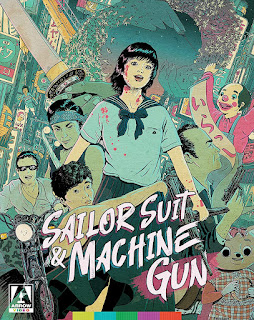
From an outsider’s perspective Japanese pop culture seems to have an unhealthy obsession with teenage girls, skimpy outfits and the ‘ol ultraviolence.  But when you actually sit down and watch something like  Sailor Suit and Machine Gun (1981), in which a high school girl inherits a run-down gang of yakuza, it’s surprising how the unseemly scenario actually plays out.  There’s an innocent undercurrent at work, a longing for family, acceptance and emotional connections that intermingles with the seedier exploitation elements.   Orphaned after the death of her father, Izumi Hoshi is met at her school by a gang of yakuza thugs who inform her she’s next in line for the position of Chairman.  Her youth, gender and inexperience don’t detract from the gang’s loyalty however as they take her under their wing in an attempt to build up the family name.  But enemy rivals are quick move in on their territory, setting the stage for a showdown ov...

Phantom of the Mall: Eric's Revenge

Image
Everybody has a favorite slasher they’ll champion to the end.  The reasons vary:  creative kill scenes, great soundtrack, retro clothes, Pauly Shore, creative use of – wait a second!  Pauly Shore?!  Yes, 1989’s  Phantom of the Mall:  Eric’s Revenge  doesn’t have a whole lot to recommend it beside an early appearance by the Weasel as an ice-cream slinging mall employee who gets caught up in a mall massacre. Director Richard Friedman, whose previous genre films  Scared Stiff  and  Doom Asylum  were equally inept, can’t make heads or tails out of the re-jiggered script built around the idea of a burn-victim hiding out in airshafts protecting his true love from a corrupt businessman.  While the teens shop, Eric practicing his crossbow and Gymkata skills in the back room hoping for a chance to get revenge…instead of, ya know, revealing he’s actually alive and pressing charges against the guy who murdere...

Mill of the Stone Women

Image
Slow to develop, the Italian gothic genre is less consistent in quality than the Hammer movies filmmakers were quick to emulate.  But amidst the genuine classics by Mario Bava and Ricccardo Freda there are a number of fascinating one-offs that are still worth attention.   Mill of the Stone Women  (1960) just so happens to be Italy’s first horror film  in color , making for a lush, expressionistic debut that does more than just splash some blood around. Structured like a Poe film, but based on an original screenplay, the story follows a young journalist, Hans, assigned to write about the lifelike stone statues created by Professor Gregorious Wahl.  Of course, there’s a reason why the professor’s art is so realistic; his sculptures are the petrified female victims used to supply his daughter, Elfie, with blood transfusions to keep her alive.   Hans, torn between his attraction to Elfie and his shock at the travesties being committed i...

The Hills Have Eyes

Image
Low-budget horror hit a peak in the 70’s with films like Tobe Hooper’s  The Texas Chainsaw Massacre  and Wes Craven’s  The Hills Have Eyes  breaking the barriers of good taste and the heretofore predictable rules of scary movies audiences came to expect.  These were the pioneers of the “anti-Hollywood” horror movie. Despite its rabid cult following,   Hills  isn’t the most accomplished film of Wes Craven’s career.     The editing is clumsy, the acting is weak and the make-up is corny (actor Michael Berryman’s misshapen bald skull makes him the only convincing inbred hick in the bunch).     At best,  Hills   is a jury-rigged minor masterpiece, held together by sheer brute force and an overwhelming sense of dread.     The film feeds off the momentum of its stripped down story about a family of whitebread vacationers fighting for survival in the desert against a family of cannibalistic madmen (and women). ...

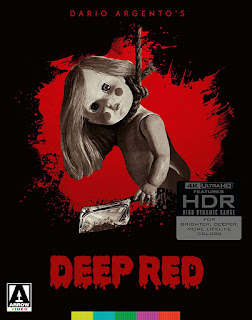
Deep Red

Image
With the release of his fifth feature film,  Deep Red , Dario Argento was probably starting to believe his own hype.  As the “Italian Hitchock,” he’d proven himself a bankable director of international thrillers (and one obscure Western) who’d inspired hundreds of imitators in his own country and abroad.   The competition was getting fierce.  So Argento fired off one last salvo into the crowded  giallo  genre that would end the debates and put him firmly back on top.   Deep Red  is one of those films that catches a director working at the top of his game with deceptive ease. David Hemmings, in a variation of his role in  Blow Up , is the witness to a brutal crime who believes he saw a vital clue to the killer’s identity…but can’t quite recall the evidence of his own eyes.  With the help of a nosy reporter (possible killer #1) and a fellow musician (possible killer #2), Hemmings stays one step ahead of a stri...

Demons 1 & 2

Image
After debuting  Demons  and  Demons 2  on Blu-ray in an exclusive steelbook format, followed by a slightly less collectible but equally spectacular looking pair of stand-alone editions, Synapse Films goes back to the well for a 4K Ultra-HD double-feature that epitomize the gonzo ‘80s Italian horror aesthetic.  Produced by Dario Argento ( Suspiria ) and directed by Lamberto Bava (son of Mario), you won’t find a more silly, sick and visually slick double feature of Euro-splatter anywhere!   At this point in his career Argento had drifted into a pattern of disconnected imagery tied with the loosest of narrative threads, designed more like  Fangoria  photoplays than linear stories.  And apparently he developed  Demons  and its sequel along the same lines, packaging both films with a prefabricated heavy metal soundtrack built around some outstanding make-up effects by Sergio Stivaletti.  There’s a screenplay in here s...